Saturday, May 5, 2018

Time Marches On


I dusted off this old blog and decided to try and pump some life into it. As the title indicates time has continued to pass and I am now in my 82 year and less than  three months to go before I am 83.

While getting old is pleasing in many aspects, the key is staying healthy and active. I had two months of ill health in February and March, I am now on the road to recovery and looking forward to getting a number of projects completed.  I once read that for every hour we work physically, we live a hour longer.  I have no idea if that is true but I like to believe it.

A serious problem with getting old is that if you get injured or fall sick it takes twice as long to recover than it did when we were young and spry.

I have included this photo I took of a doe and her young fawn, right in front of my driveway, after exiting my woods.  I saw them many times in the woods and had the feeling this was the first time the doe took her offspring out of the woods into the open fields. The fawn was just bounding and bouncing with apparent joy.

I kind of think I feel the same way about my eighty-second spring.

Thursday, February 12, 2015

Old Barns and Cupolas

 
On a recent road trip through the south central part of our county I endeavored to find and photograph the last of the old barns and fancy cupolas. In almost every case the house is empty and the farm abandoned, while the barn is in a sad state of disrepair.
 
 
Perched high above the farm yard sits the barn cupola.  They came in a variety of shapes and sizes. In the beginning they were all made of wood and hauled to the roof peak during the final stage of construction. Carpenter took some pride in finishing the barn with a unique cupola which included an arrow weather vane which always started out pointed north. Strong winds and winter storms made it a challenge to keep the arrow pointed north. The fanciest ones also indicated the four main directons of the compass with the letters N, E, W, S.
 
 
Sometime during the 1940's and 50's they began to appear in all metal construction and were factory made. This limited the variety of the designs but they did get a little more fancy, while the metal increased their life considerably.
 
During the active life of the barn the top of the weather vane was decorated by a typical rooster, farm animal or a special design such as a sailboat.
 
 
As the farms were abandoned these decorations were either shot down by vandals or removed for safe keeping.  It is unusual to see one still in place today.
 
 
Note this unusual pair, each with four letters of the compass.
 
 
If you have any knowledge of any existing barn cupolas, particularly ones with a weather vane, contact me and I will try to take some photos.


Friday, February 6, 2015

Life expectancy in 2015

I took a few self portraits today. I plan to change my profile portraits on-line and keep up with the ravages of  time. It is too late to make any drastic changes.  I must just accept what I look like and concentrate with staying healthy and active.

When I was born back in July 1935 in Canada I believe my life expectancy was under 70 years. In less than five months I will be 80 years old and have a life expectancy of 87, up one year from my my previous calculation.  One of the good things about becoming a very senior member of society is that your life expectancy stays apace. So that's not a bad eightieth birthday present.

My present goal is to press on to at least 90 years of age.  I will endeavor to maintain my blog on a regular basis and try to increase my followers. They increased by one this January so I now have a total of four. I do not endeavor to reach a large number of people just for the sake of the numbers. However a steady increase would indicate my blog content is on the right track.

Perhaps I might even receive a few comments from readers to just prove they exist.


Sunday, January 25, 2015

Uncle Eric's house

When I first came to this area of Kittson County, MN some thirty five years ago I tried to buy some land where I could build a house.  For a brief moment in time I tried to buy the nine acres of land that Uncle Eric's house sat on, but it was not for sale. I was not related to Eric but the house was always referred to by others as Uncle Eric's.


 The house sat forlornly on the edge of the riverbank woods at least a half mile from the nearest road. It had been built in the early 1900's so it was over fifty years old during my first visit. Erick was a farm laborer and worked mainly at farms in the area and at the same time tended his few acres. For a couple of the early years it seems he had his deaf sister living with him and they communicated by sign language.

 
The house was vacant when I first saw it and remained that way ever since.  Uncle Eric and his sister died at least fifty years ago and the little house has faced time and weather alone and in silence ever since. With the farm field on one side and the river behind it, access to the site was difficult but it could be seen briefly through the trees from the high side of the river a half mile away.

During the period of time I have lived in the county I have watched many a house and barn demolished by so called progress. Many other died a slow death from a broken back caused by snow loads in winter.  Others were burned and the remains buried.  Recently I realized that Uncle Eric's place was not going to last much longer so I grabbed my camera and the snowshoes and headed out.

This river photo was taken near the road closest to the house which lies in the distant tree line on the farthest side of the field.  The house sits in the trees to the left of the opening you can see in the woods on the sky line. The river swings wide to the left in a half circle and passes behind the house.
 
The snow was deep so the first challenge was to get down the steep river bank in the foreground and onto the frozen river. We had experienced a number of very cold nights before there was much snow on the ice so I was confident that the ice was thick and safe.

The second challenge after crossing the river was to get up the steep river bank on the far side. Once I was up the deep snow on the bank I passed through the old gate opening and started my trek to the distant house. My snowshoe track can just barely be seen to the left of the fallen tree seen in the photo. The nearest residence is at least a half mile away as the crow flies.


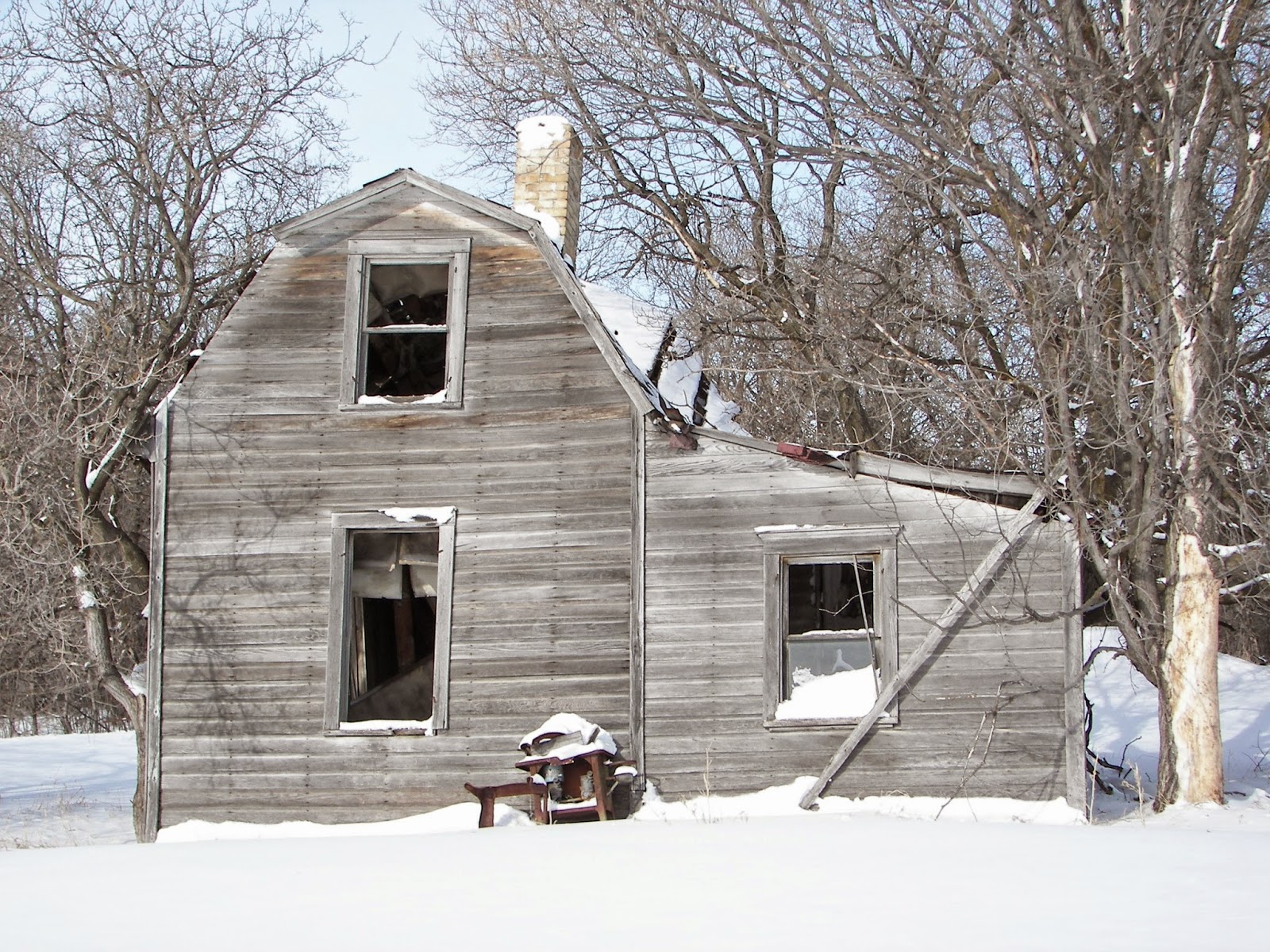
The close-up photo of the house shows it was a story and a half with a lean-to on the right hand side. The front door is missing along with the steps. Only one pane of glass remains unbroken. Notice it had a solid brick chimney.  The old weather grey siding shows very little of what remains from the original coat of white paint.
 
 
The photo from the rear of the house indicates it was a small home and the winter snow loads over the course of many years has broken its back. The final collapse is only a winter or two away. (The following winter it gave up the fight and was crushed flat by snow.
 
The last pane of glass is doing its best to hold the snow back, but its too late. Even the trees around the house have died.
 
The trip back across the field and river bank was uneventful but the struggle up the river bank was a trial. Later I realized the effort was worthwhile when I learned the little old house was down.

Thursday, January 22, 2015

Mystery tracks in the snow.

On a recent snowshoe outing in our woods in Northwestern Minnesota I came across a track in the fresh fallen snow.  As I stood there looking at it I was unable to think of what kind of animal would make such a track.
The track was continuous and had a half round shape as if it had been made by a fat snake. I rarely see a track that I cannot identify because there is a limited amount of wildlife in my woods, especial in the winter.

With my curiosity aroused I started to follow the track and then noticed a couple more of the same type. After a short walk I came to what I realized was the beginning of the tracks and took another photo. ( See next photo below)

This spot was very helpful because it indicated that some type of bird had landed in the snow. The
   Photo shows that the bird approached from the left and marks of it two feet can be seen to the left     of the hole in the snow, showing where it landed. This hole was deeper than the rest of the tracks. A bird when landing sets its wings and makes a downward beat to slow the decent. The long marks in the snow to the left of the landing hole shows where the edge of the left wing touched the snow. Five distinct marks show where the wing tip feathers made a light mark.

The imprint and track showed me it was a large bird and had to be a Ruff Grouse as at least six presently reside in these woods. In normal winter conditions a Ruff Grouse walks on the surface of the snow with ease, and rarely sinks in more than an inch.  This bird was sinking in at least six inches and was having to push forward with its chest to make any forward movement in the soft snow and this resulted in the unusual tracks.

The third photo shows the landing site of another grouse that came from the direction at the top of the photo.  Again the marks of the feet can be seen at the tope of the photo while the wing tip feather marks are seen on the left side of the photo.  As the birds wade off, they sink so low in the snow that the bottom parts of the folded wings leave drag marks in the snow.

Once I felt satisfied that the tracks were left by Ruff Grouse I tried to understand why these birds were sinking so deep on the snow.  As I  thought back to the beginning of our recent weather I believed I had the answer

A few days ago we received two or three inches of light fluffy snow the slowly fell during the night and early morning. This was followed later in the day by strong winds that ranged from thirty to forty five miles an hour and created a ground blizzard across our region.

The winds stripped the loose snow off the fields until it was airborne and blown in vast clouds across the landscape.  Where ever the winds blew across wooded areas the winds were slowed and the snow settled in the woods. As the storm drew to a close the winds died down and these vast clouds of snow settled gently in the protected woods.

The ground blizzard resulted in the top five or six inches of newly deposited snow to be so light and fluffy it would not support the grouse and they sank chest deep and had to struggle to move about.
The fact that the grouse experienced a mild fall and were rather fat and heavy contributed to their problem.

The mystery of the strange tracks in the snow was solved.


Thursday, January 1, 2015

New Beginnings

I last posted to this blog March 15th 2011 and that makes it almost four years ago.  I find the length of that gap hard to believe.  There were many reasons, but mainly I seemed to just get too busy and let everyday life run me.  Since today is the first day of a brand new year I thought that it was a good excuse to restart my blog and my reflections on life past, present and future.

Another excuse is the fact that I purchased a new camera and have a great urge to get out and photograph the county around me and test the new features it provides. I bought a Kodak PixPro AZ521 with a 52X lens.

 Last, but not least, I have to consider that I could  be running out of time.In six months, give or take a day, I will reach my eightieth birthday. I hardly need more incentive to contribute something worthwhile to my blog.

To test the camera I headed for the north branch of the Two river a few miles away. The snow was only a few inches deep so it was not difficult to get about. It was a bright sunny day and right away I found I had a problem. The new camera does not have the usual view finder.  This camera is fitted with the new three inch LCD screen.  The bright sunlight made it very difficult for me to compose my pictures.  Keep in mind that I have owned a camera since I was fourteen years old and they all had a view finder. I have no choice but to adapt and learn how to use the new screen. I did a little research when I got home and discovered that I could increase the light intensity on the screen and bumped it up to the highest setting.  I will see if that makes a difference on my next outing.

The following photo shows the Two River a few miles northeast of Lancaster.  I have canoed it a couple of times in the past.  The land the river flows through is very flat farmland but the river has cut a decent channel through the terrain with the result it is very scenic from the seat of a canoe.


One of the main features of the camera that attracted me was the zoom lens.  To test it out I found the remains of an old log barn and took a couple of shots that show the log construction and the grain in the wood.  The photos were taken from some distance away and not with the close-up feature.  


I believe this barn was built very close to a hundred years ago and the roof has already been ripped off.  The balance of the building will soon be destroyed. you will notice that the corner construction of the walls was not built in the typical log fashion where the logs were cut and stacked to overlap the lower row and stick out six to ten inches.  In this example the ends of the logs were cut off even with the face of the wall.


The photo of the gray wood from the old window makes me think of the great number of rain storms and snow storms it has experienced.  How many times did the old farmer look out through this window to check the weather before beating his way through the snow drift to the safety of his home.


As I left the old abandoned farm site a Ring-necked Pheasant flew across the yard in front of me. As I fumbled with my camera settings a second one left the shelter of the woods a few seconds later.  They are the first ones I have seen locally in at least ten years when they were more plentiful. Our milder winters will increase the odds of their survival.  As I drove away I was disappointed that I missed the chance to test the camera on a flying peasant.


Note that at one time the cracks and holes in the wall were filled with mud or cement and little of it remains.

Tuesday, March 15, 2011

Ground Blizzard - 60 mph Winds

The forecast warned us many hours in advance that North Dakota and Northwestern Minnesota was going to be hit with a blizzard. Early reports from western North Dakota confirmed 60 mph winds with gusts over 70 mph. As the day progressed and the storm failed to appear, many people, writer included, continued their daily routine. By dark on Friday March 11th, 2011 we had strong winds but little snow and it appeared the brunt of the storm was going to miss us.

I drove into town late in the evening to visit friends, but I kept one eye on the weather conditions outside.
One favorable condition of the storm was the report that it would end by midnight. I waited until after midnight and then got in the truck and headed for home a few miles away. While still in town I appreciated that the winds were still very strong and any snow in the air was being driven horizontally.

As I left the protection of the town the winds increased, as did the blowing snow. When I was about a mile south of town all protection from buildings and trees were left behind and I drove into the full force of the storm. As I continued south the wind blew from the northwest and the sky filled with blowing snow that crossed my path from right to left.

On the prairie, snow blowing firecly across the road has a tendency to cause a driver to drive in the direction of the snow. Headlights are virtually useless as the snow in the air reflects the light back so you see nothing but white snow in front of the vehicle.

The blowing snow has a hypnotic effect on the driver and it takes concentration to stay on the road. To make matters even worse an increase in the wind causes what we call a "white out" when absolutely nothing can be seen for four or five seconds. Just the sound of the storm is enough scare you.

When I lost the last protection from the trees, I slowed right down and had to look out the drivers window at the ground. The pavement was free of snow as the winds were so strong the snow was blow across it and out into the open fields. No other vehicles were on the road so there was only a minor chance of running into something.

It was at this point that a firece gust of wind caused a white out and I was unable to even see the pavement out the side widow.  I applied the brakes and brought the vehicle to a stop and sat there waiting for visibility to improve.

When I went to move forward the truck would not move.  I opened the door and saw snow.  I was no longer on the road.  With difficulty I got out and walked around the truck in the blinding winds and snow.  I had to hold onto the truck the whole time or I would have been blow into the field.  I soon determined that I had crossed the highway to my left and was now sitting still facing north, but on the side of the ditch.

I was only a few feet from the pavement but the tires on the left side were in a foot of hard snow while the tires on the right side were in six inches. I tried to back up in my tracks but they had already filled in with snow.  Any attempt to rock the vehicle back and forth did no good because the snow was packed hard.

The roar of the wind was so strong that it would have been very difficult to talk to someone, if I had not been alone. It was impossible to face the wind and snow and you could only look down at the ground or down wind. The truck was being buffeted strongly by the blizzard winds and was rocking from side to side.

When I got back into the truck to warm up I realized I had three options. The first was to stay put and wait till morning or until the storm blew itself out.  I had enough gas and was warm so that was the best option.

The second, was to try and dig the vehicle out, get back up on the pavement, and slowly work my way home. The last option was to leave the vehicle and walk the mile or so back to the house. All the advise in the world states, stay in your vehicle. Most people die when the get lost in the blizzard and walk in circles until they finally fall down and freeze.

After sitting a short while, I decided that I would at least try and dig the vehicle out as I always travel in the winter time with a large shovel, known locally as a grain shovel.  I was wearing a warm coat and had on my head a stocking cap. So it was up with the coat collar and down with the hat and I jumped out.

I started at the back of  the truck where the loose snow lay in the tracks.  I was able to shovel the loose snow away and with each shovel full I hardly had to lift it up a foot and it was instantly blown from the shovel and took off into the darkness for parts unknown.

After about five minuets the cold winds and snow would force me back into the truck to warm up. I was in and out a half dozen times before the snow was cleared from behind the truck. I also cleared the snow away from behind the front tires. A couple of times the wind grabbed the lower section of the shovel and I almost lost it, had I not held on tightly with one hand on the handle. It was a very good demonstration just how strong the winds were blowing.

Getting back in the truck was always difficult as the wind first tried to rip the door off, then made it difficult to get the door closed again. Once I was warmed up I tried to back the truck up. By driving forward and back for about three feet I made room to make a run at backing up. In a matter of moments I was  moving freely but then the tires started to spin, they lost traction and the back of the truck started to slide down the slope into deeper snow in the ditch.

The only choice was to get back out and continue shoveling. After a few more tries at backing up onto the road and sliding further into the ditch I gave up and got back into the truck to warm up. Once I was warm I decided that I had to change my plan and try to drive forward. It would mean shoveling away a lot of snow in front of the truck as well as  from under the vehicle and back tires.

At the point the wind started to work for me.  As I cleared away the snow down to the dirt and grass the wind kept in clean and no further snow built up. After many trips in and out of the vehicle I had enough snow moved away to attempt to move forward.

It is at this point you realized that if it does not work you will be forced to spend eight or ten hours waiting for help.  I cautiously put the vehicle in gear and it began to move forward but then once again the back tires lost traction and moved down the slope. The truck was now facing the road and the rear was much lower than the front tires which were on the gravel shoulder. It was time to rest and think things over.

Digging in the cutting wind and snow takes all your energy and concentration.  I could think much better when I was in the truck and warmed up. I realized that with the front end on the edge of the road I not longer had to worry about shoveling snow from the front tires and could concentrate on the back.  If  I could dig down to the dirt in the ditch I should be able to get traction and get out. It was worth a final try.

Out I went for one last try. The wind and snow had not let up in the slightest but now any snow I dug away from under the vehicle and around the tires was whipped away and kept away. After many in and out trips I was ready to make my last attempt. As I shifted into gear and applied the gas I could feel the tires starting to dig into the dirt. The more dirt I dug, the more dirt it packed in behind the truck so I was able to rock the truck back and forth until I got more room to make the run up the slope.

Eventually, with each roll back and forth I was able to climb the slope higher and was very happy when the back wheels reached the pavement.  It was at the very moment, when I sat sideways blocking the entire road, that I had thoughts of some large truck appearing out of the blizzard to hit me broadside. Not good.

I was very quick to get turned south and then with the door window open I watched the pavement very carefully. A couple of times I saw the yellow center line and moved right to stay on my side of the road. The winds kept trying to force me across the road.

The vehicle moved at a crawl as I knew I was close to my road where I had to turn east. I could see a sign between the gust of snow that showed I was at the intersection.  I made the turn very slowly as I had no intention of going back into the ditch.

My spirits were lifted when I got on the gravel side road and slowly started eastward. At this point the winds seemed to be coming more for the west, blowing the snow down the road ahead of me. I left the window open and stared down at the gravel on the road and made sure I did not leave it for the snow filled ditch. It seemed to take for ever as I moved forward at a crawl, and a lot slower than a person could walk.

After almost a mile I reached the protection of my woods that was to the left and this slowed the wind down so I had a little more visibility.  I was a pleased to see my mailbox by my driveway. Once I turned into my drive and my woods, visibility was almost normal and it was a great relief to turn off the truck and head into the house.

The next day I had a few sore muscles from the marathon of shoveling but I considered myself lucky compared to the many people that spent anywhere from eight to eighteen hours before they were rescued.

So far I have not heard of anyone that lost their life. I got home at 2:30 a.m

Friday, March 11, 2011

Interesting Statistics

As you read this, my 64th post, please note the recorder in the upper right hand corner of this page. Below the numbers you will note the words "view my stats".  If you place your cursor over these words they will turn light blue. Click on them and a new page will open that shows this weeks numbers of the people who have visited this Blog as well as the number of pages they have visited.

While the numbers are rather low, they do show a very slow growth. What I find even more interesting is when I go down the list on the left hand side of the page to the 18th item that states, Recent Visitor Activity.

If you click on this heading you will be taken to a detailed list of the more recent visitors. In most cases a person simply reads the page they searched for and then moves on.  In that case the time spent on the page is simply recorded as zero.  If the person moves to one or more different pages the time spent is recorded.
I am quit surprised at the number of people who spend up to an hour or two reading many posts.

What is even more interesting, and some times down right surprising, is the information displayed when you click on item 19 on the left hand list, called Recent Visitor Map.  When this page opens it displays a map of the world with a marker over each town where a recent visitor resides. Clicking on a marker results in a pop up with more information. The markers are constantly being added and subtracted as I believe they only remain about a month. In other words the map shows the visitors to this page during the last thirty days. It only proves that the Internet continues to shrink our world.

Thursday, March 10, 2011

Thoughts of Spring

This post is merely to confirm I am still alive, though I barely survived February with a serious case of the Flue. This is the time of the year we search desperately for any signs of spring. I have heard a few crows so that is one indicator.

Late last night the coyote pack was howling in unison with the occasional solo, which my dog replied to. They are on the prowl looking for winter killed deer.

If you look carefully you will see small signs of the snow retreating. The south facing ditch banks are almost free of snow, so I know woodcocks will soon appear .They are a very hardy bird that likes to reclaim their territory and nest very early.

Having said all that, I must get back to work writing some new posts, before the few loyal readers I have give up on me.

Friday, February 4, 2011

Freezing Rain in February

I awoke during the night from the sound of raindrops on my window pane. It was hard to get back to sleep what with worrying about all the problems it causes. The worst is the build-up of ice on the power lines, coupled with strong winds which pull down the lines . No power, no sump pumps, equals water flooding the basement.

Ice on the windshield a quarter of an inch thick gets the day off to a good start. Car door hard to open, windows frozen shut, roads like a skating rink.

But all that is minor when considering the effect freezing rain has on wildlife. With our two feet of snow, a frozen crust cuts the front legs of deer as they walk. Owls are unable to break through the crust to catch the mice they hear under the snow. Ruff Grouse can be sealed in their overnight shelter and starve to death.

I am not going to complain as I will not suffer any injuries or die of starvation.

Tuesday, February 1, 2011

More Snow and Colder Weather


This morning started out at -18F, the second of two cold nights, with one more to go this evening.

By afternoon it was a sunny and a balmy -3F, so it was time to hit the snowshoe trails.


With three to four new inches of fresh snow, that makes a total of at least twenty-four inches of snow on the ground. The snow depth is very obvious on any large logs laying around.


The packed snowshoe trail is only six inches below the overall snow depth. Without snowshoes, the snow is knee deep and very difficult to walk in. The dog occasionally forgets and ends up floundering up to her chin.

The frequent snow falls through out January has made it difficult to keep all of our trails packed down. One in particular was deep with fresh snow so it was slow going. The old dog was not too happy as she has been spoiled with travel on the packed trails.

Monday, January 31, 2011

Flying Underwater

One spring, as the north end of the Lake of the Woods began to thaw, I headed out into the open water in my canoe. The distance I could go was limited by the ice. Where there was the slightest current, that was where the ice melted first.

As I explored the sections of open water, I noticed a single duck swimming some distance away. When I paddled towards it, the duck moved away ahead of me. The channel slowly narrowed, until it was no more than six feet wide.

Since it was a duck that I was not familiar with, I kept paddling slowly towards it in the hope of identifying it.. As the distance narrowed, the duck suddenly found that it no longer had enough open water to take off in.
I expected it would hop up on the ice and take off from there.

To my surprise, the duck simply dived underwater and disappeared. Because of all the ice, the only open water was behind my canoe, so I looked down into the water to see if I could find the duck. Within a few seconds I saw the duck about ten feet below my canoe and it was moving swiftly through the water by using its wings as if it were flying.

I had seen many ducks and loons dive under water but they seemed to use their webbed feet to propel themselves. In this instance the duck was flying in the water, similarly to the way it flew in the air, with its wings fully outstretched. I watched as it flew below the canoe and then popped up behind me in the open water. From that point it quickly ran across the surface of the water and took to the air.

The ease with which the bird moved through the water was impressive, as it seemed to move effortlessly but with speed. The entire demonstration took place in a matter of seconds, but I was able to identify it as a male Common Goldeneye.


Wednesday, January 26, 2011

Saved by "A Flash of Light"

I was directing traffic in Banff, Alberta, one day, at a minor traffic accident, when a passing motorist rolled down his window and asked, “Was anyone hurt in that accident where the car went through the guard rail and down the cliff?” “What accident and where?” I enquired.

I quickly obtained a good description of where the accident occurred, thanked the driver for the information and waved him on.

Once the damaged cars had been cleared from the intersection, I got on the car radio and contacted the dispatcher in the Calgary sub-division. They had no reports of any accident as I described. At that point I contacted the Canmore Detachment, as the accident scene was in their area. They had no knowledge of the accident.

I carefully explained where the accident was located in the mountains, on a very sharp curve, where there was a very steep drop off down the face of the cliff. The key was to look for the any damage to the guard rails.

Within the hour I heard radio traffic and realized they had found the vehicle with the driver still in it and a rescue was taking place. After that I was distracted with other duties and did not hear any additional details.

About a week later I was on the phone with the Canmore Detachment on another incident, and when I was done I asked them about the accident where the car went over the cliff.

I learned that they had a great deal of trouble locating the car as there were no tire marks and no damage to the guard rails. The vehicle could not be seen by anyone standing on the road at the point where the car went over the edge.

The driver of the car that first reported the accident to me, was very careful to point out that he noticed the wrecked car only because the sun was reflected off the windshield, when they were about a half mile away and approaching a u-shaped curve. They were at the top end of one side of the curve and the wreck was at the top end of the opposite side of the U.

It took some time to realize that the car could only be spotted for a second, in one specific place on the highway, some distance away and down the side of the mountain. Many spruce and pine trees hid the vehicle. Both before and after passing that point, it was impossible to see the wreck.

Eventually tire tracks were found in the dirt, where the vehicle had gone between the guard rail posts without touching any one of them. The car dropped down the steep slope about a hundred feet and became lodged on its side between the mountain and the base of a large pine tree.

Mountain climbing gear had to be used to lower a rescuer down the side of the mountain to the car.
It was discovered that the male driver was still alive in the automobile, and terrified to even move. Because the car was on its side he was sitting on the driver’s door and looking down through the glass, to a the bottom of the valley, very far below.

Each time he tried to move, his weight shifted the car and it seemed about to fall down the steep cliff.

Later it was determined that he was not paying attention to the road, but was enjoying the scenery, lost control of the car and went over the edge, but was saved when the car jammed between the tree and the cliff.

The rescue of the driver took place many hours after the accident had occurred, and at a time when he thought he would never be found. He yelled for help but could not be seen nor heard. He would probably have died, long before he would have been found.

Recovery of the car was even more difficult and all traffic on the road had to be halted for a number of hours until the job was done.

The man was saved only because a very observant driver saw "a flash of light" off the windshield and realized it was a car. He assumed it was an old accident but spoke to me only because he was curious about the details. I was too busy at the time to get his name, but I did follow up on the report and was happy to hear the driver was saved.

Tuesday, January 25, 2011

Mountain Driving at Night

One very dark night I was driving my car from Banff, Alberta, and heading for Calgary. The old highway I was traveling on clung to the side of the mountain, with a steep drop off to my right and a cliff to my left. The road wound back and forth with many curves that did not allow any distractions.

There was no other traffic in the beginning, but eventually I was passed by a brand new 1955 Buick on one of the few straight sections of the road. I was driving a 1953 Hillman convertible which had trouble with the hills, but handled the mountain curves with ease.

As the miles passed, I would catch up with the other vehicle on the curves, but then fall back on the straight sections, which were few. Normally I do not like following another vehicle, but it was such a pitch black night I appreciated the lights of the car ahead, as he gave me warning of the direction of the curves.

The miles were sliding by, until we ran through a serious of sharp curves, during which I caught up. We then reached a straight section of the road which led down a slight hill.

Suddenly, with no warning, the tail lights of the other car came on, in what was obviously a panic stop. I immediately applied my brakes and the two cars skidded in unison down the highway. I can clearly remember seeing the smoke curling up from behind each of his rear tires as he was skidding. Almost at the same time, the Buick smashed into something on the road, and a short distance later, came to a full stop.

I managed to get my vehicle to stop with less than ten feet separating our vehicles, but I stalled the engine. The headlights on the Buick were knocked out and just the tail lights remained on.

I got out of my vehicle and as I walked forward, the other driver got out. I asked him what happened but he did not know what he had hit. All he saw was a dark object on the road just before he smashed into it. Steam from his broken radiator was leaking out in the cool night air and it was very difficult to see. The other driver was not injured but he was quite upset.

There were no towns or even homes in this area of the Bow River Valley, so it was pitch dark in every direction. As I had a flashlight in the car, I went back to get it, so we could check the damage.

When I came back with the flashlight, we examined the front of the car and found the entire front end smashed along with the hood and fenders. We found blood on the road and it led to the edge of the highway and then down into a steep ditch.

I suggested that he had hit an elk, since they were numerous in this area of the mountains. When I grabbed the flashlight I had also grabbed my service revolver, in case we had to put the injured elk out of its misery.

My flashlight was not very bright so we proceeded slowly, down into the steep deep ditch. Once we were safely down the slope I shone the light on the other side of this very dark ditch.

It took a second for it to sink in, just exactly what we were looking at in the puny beam of light. Standing upright with both front legs spread wide was the biggest black bear I had ever seen. Its mouth was open, its eyes were glaring and blood was dripping from the jaws.

In one motion, the two of us spun around and climbed out of that ditch with record breaking speed.
As we ran up onto the highway I took a quick look with the flashlight to see if it was following us. While still running, I saw the bear fall backwards on to the far side of the ditch bank and lay still.

It took a few moments for us to calm down and get our hearts beating at a somewhat normal rate. Then I slowly moved back around the front of the smashed car and checked out the location of the bear. By this time it was lying motionless on its back and the eyes were closed. We waited some moments to make sure it was not breathing before we checked it up close.

The bear had died from massive injuries, but had enough strength left to stand up as we jumped down into the ditch. It was probably as frightened as we were in the last seconds of its life.

We left the Buick with the tail lights on and set out some warning reflectors before I drove the owner to the next town where he could hire a tow truck. I continued on to Calgary and was quite wide awake for the rest of the trip.

The next morning on my way back to Banff, I stopped at the scene, but everything had been cleaned up, including the bear. I found out later that some local Indians had removed the bear and made use of the bear meat, and in particular the bear claws.

Wednesday, January 19, 2011

Snow on the Ground and talk of Flooding.

Just returned from snowshoeing on the trail through our woods. It was -15F this morning, but had warmed up to zero when we hit the trail. The recent cold weather and cold winds dampened any enthusiasm for snow shoeing until today. We have had a number of snow storms so all the trails need packing down.

I measured the snow depth in the woods and it averaged eighteen to twenty inches.

On the edge of the woods the blizzard winds have made drifts three to four feet in depth.

We are hardly half way through this winter and talk has started on the subject of flooding in the Red River Valley. It can snow a lot in the next few months, so I believe flooding is a sure thing.

We sit about thirty miles east and 117 feet above the Red River, on an old sandy shoreline of  ancient Lake Agassi, so we are in no danger. That does not mean that we are not sympathetic to those people who's homes sit in the flood plain.

For the rest of the winter, every new snowfall is only going to make it worse, and a lot of snow can fall in February and March. Colder weather and more snow is forecast.

Tuesday, January 18, 2011

Bow River Valley - Canoe Recovery - Part 3

Read Part 1 & 2 first
Once I had a chance to review my situation, I realized that I could use the tree at the end of the gravel bar to get to shore, over the fast river current. The tree however was half in the water and the branches made it difficult to climb onto. I dug out my hatchet and cut a number of branches off, and as I did so, I saw the tree lift a little out of the water. At that point I chopped off a large upper section of the tree and the removal of that weight allowed the tree to spring upwards, so that it no longer lay in the river.

Earlier I had tipped the canoe over and removed all of the water. I could now lift the canoe across the gravel bar and onto the side closest to the river bank. I carried extra rope, so I attached a long piece to the nose of the canoe. I carried one end of the rope as I crawled across the tree and onto the shore.
At that point I was able to walk upstream and pull the canoe across, without it hitting the last tree.

I decided that if I could find the paddles I could continue my trip, so I started walking downs stream, checking the banks. As I walked around the next curve I found a paddle jammed into some brush along the shore and was able to reach it. I continued further, looking for the second paddle, when I came to a shocking sight.

Blocking the entire river was a huge log jam built up with at least fifty big logs. The jumbled pile was eight to ten feet higher than the water, with some logs sticking up even higher. The entire river rushed under the logs and came out on the other side as a mass of foam. I stood there transfixed by the sight.

It did not take me long to realize that if I had not swamped my canoe, I would have had no chance to survive the encounter with the log jam. I would have been sucked under the logs and pinned there and drowned.

I suddenly felt much better about the dunking I had experienced.


As I walked back to the canoe, I decided that the river could hold similar surprises down stream and it was a good time as any to call it quits. Once back at the canoe, my change of plans meant that I had to move the canoe and equipment from the river, nearer to the side of the mountain.


I explored the area and found another creek. I had to drag the canoe some distance but was soon back in calm waters and moved closer to the mountain. I did not hesitate to leave the canoe and equipment, as I had not yet seen anyone since I passed the trout fisherman, some twenty five miles earlier.


The climb up the steep side of the mountain was difficult, but I managed without the need of any climbing equipment. After about an hour, I reached the Trans-Canada Highway and got a ride with a local trucker into Banff. The driver made it very clear he thought I was crazy to have run the river in a canoe and thought I was very lucky to get out with just a dunking.


After a warm shower and a good night’s rest, I was back the next day to recovery my canoe and equipment.
I had my dried out camera so I took photos of the river where the mishap occurred, and during the recovery of the canoe and equipment.


The steepness of the terrain made it impossible to carry the canoe, so I hauled it up the steep incline by using a long rope. I tied the rope to the nose of the canoe and then carried the rope up and around a stout tree, some distance uphill.

 I then went back to the canoe and with the rope end in one hand and the other hand on the canoe, I moved it up hill. The rope prevented the canoe from sliding back down the hill, until I reached the tree. I had to repeat this many times but eventually moved the canoe up the side of the mountain and to the highway and car.

Once the equipment was in the trunk and the canoe was on the car-top carriers, I was on my way down the highway, back to civilization.

Monday, January 17, 2011

Bow River Valley - Swamped by a Sweeper - Part 2 of 3

Read Part 1 first.
I got off to an early start the next morning. After a hearty breakfast, I soon had the tent down and all the gear packed and ready to go. Once on the water, the miles of mountain scenery began to slide by endlessly.

As the hours passed, the river got narrower and deeper, and began to wander back and forth from side to side in the valley. The bends and curves got sharper, so it was impossible to see what was around the next curve.

The water runs swiftest on the outside curves and much slower on the inside. The current is constantly cutting away the bank on the outside curves, and caused trees to topple into the water. The slow inside curve builds up the gravel. When I could, I stayed on the inside of the river bend, where I had more control of the canoe.


Eventually, I approached a curve where the river made an abrupt u- turn to the left. I endeavored to maneuver to the inside of the turn but the current swung the back end of the canoe around so that I ended up going sideways, down the middle of the river. It was at this time I caught sight of an undermined tree lying across my path, but still anchored to the right hand bank.

These are known as sweeper trees.

There was no way I was going to be able to paddle to my left and get around the end of the tree. Only the tip of the tree was in the water. The trunk of the tree was suspended about eight inches off the surface of the water. I could see that I was going to hit the tree with my right side, and I could expect to be swept out of the canoe and into the river.


At the last minute I leaned to my left so that the entire right side of the canoe would hit the tree, rather than go under it. There was not much else I could do, as I braced for the impact. The canoe hit the tree and stopped instantly. The river water simply rose up on the left side and poured into the canoe, filling it in an instant. The swamped canoe sank and rolled under the tree upside down. I went along for the ride.

I followed the canoe to the surface just in time to see a second similar tree blocking the river. The canoe easily rolled again, under the tree. I ducked underwater and followed. As we came to the surface the canoe was pointed down the river but floating upside down. As I started swimming after the canoe, I noticed my cap was floating down river with me. I reached over and grabbed the hat and put it back on. It seemed the sensible thing to do at the time.

When I caught up to the canoe, I grabbed onto the back end, and rolled it right side up. It was filled with water and just the gunnels, or sides of the canoe, showed above the surface. Up ahead I could see a gravel bar in the middle of the river and managed to steer the canoe to it. I climbed up on the gravel bar and dragged the canoe up high enough so it would not be swept away.

It was at this moment that the shock of the ice cold water hit me. I stood on the gravel bar in the middle of the river, shivering with the cold. My hands were stiff as I awkwardly removed my shirt and pants. Once I’d rung out most of the water, I put them back on.

Still shivering, I checked the contents of the canoe and found that I had lost both paddles, but everything else was still securely packed. I dug out my camera from the packsack and saw that it was still there but rather damp. I rewound the film into the cassette then opened the camera to drain out the water.

Note - I was able to get the film developed and printed at a later date, but most of the photos were watermarked, as can be seen in some of the earlier photos. The rest of the photos were taken with a dry camera the following day, as I recorded the site of my dunking.


This photo was taken the next day, looking back up river, and shows the two trees I went under with the canoe. The curve I came around is to the right middle of the photo, behind the two small pine trees.


This photo shows a third tree, with the gravel bar to the left of it. This tree was lying in the water, but still anchored to the river bank. The river was rushing past on each side of me so fast, any attempt to swim to the shore would simply have swept me downstream.

Since I had lost both paddles, I could not use the canoe. I was stuck on a gravel bar in the middle of a fast flowing river. I had a problem.

Continued in part 3.


Saturday, January 15, 2011

Bow River Valley - Canoeing - Part 1 of 3

When I lived in the mountains at Banff, Alberta, I vowed that some day I would make a trip from Lake Louise to Banff, a distance of about forty miles, by running the Bow River in a canoe. The river is fed with melt water flowing from the mountains and glaciers, all along the Bow River Valley.

The opportunity came in August of 1961 when I was 26 years old. It was a gray day, but I was committed, no matter how the weather turned out, as my window of opportunity only gave me three days. I planned to make the trip by myself and had camping gear in order to stay out overnight.

Early one morning, I put my canoe in the river near Lake Louise, and headed down stream. The view from the water was spectacular. High mountains sat on either side, with thick evergreen woods down their flanks. The trees were thick along each river bank, with nary a road, a trail, or the slightest sign of civilization. This entire area sits in the middle of Banff National Park and every effort is made to keep the area a pristine wilderness.

The river starts out rather wide, swift and shallow. The current is too fast to paddle against, so the run down river is exhilarating. The swift current limits the work with the paddle to steering, and in particular to avoiding rocks and dead trees.


After about fifteen miles the river narrows and becomes very winding. The valley flattens out, the river is deeper, and it is difficult to see what lies ahead, around each new bend. The entire course of the river is complete wilderness, as it has been for hundred of years.


During my journey, I only saw only one other individual. He was a trout fisherman standing in hip waders, in a long, swift, shallow rapids. He was facing down stream, so he did not see me coming, until my canoe suddenly raced by him. Just as he cast his line, I yelled a friendly “Good morning”, and left him standing with his mouth hanging open, and a shocked look on his face.


The river has the occasional small creek leading into it from valleys on either side. The water in them had ceased running, once the spring run-off was done. They allowed me to paddle away from the river and set up camp in an ideal quiet spot. The only road in the valley was the new Trans-Canada Highway. It ran parallel to the river, and higher up on the side of the mountains, some distance away.

Just before dark I set up camp, took a few photos, then ate, and climbed into the sleeping bag. I was looking forward to completing the second half of my trip the next day. I was soon lulled asleep by the sound of the rapids nearby.              Continued in Part 2.

Friday, January 14, 2011

Mid-winter Photography

It is very easy to set aside the camera during the winter months, and wait for warm sunny days. In Northern Minnesota that means four our five months will pass without taking a photo. I make a point of taking my camera with me during winter outings and keeping my eyes open for subjects that would make an interesting photo.

Last winter I was driving out in the country and passed and old fence line that had seen better days. Long grass and weeds struggled to stay upright in the deep snow. The fence wiring was rusted and stained the old posts. It’s useful days are over. I stopped and took two photos and moved on. Days later I checked out the photos on the computer, and was pleased to see they looked even better than I expected.


The beauty of a digital camera is the fact you can take all kinds of photo and simply delete the poor ones, without having to pay to have them developed. When I first got a digital camera I acted as if I still was using 35 mm film and only had 24 shots available. Back in those days you rationed out your shots, so that you did not run out of film. Now that I have made the transition to digital, I end up taking fifty to a hundred shots on an days outing, and that increases my percentage of successful photographs.

Thursday, January 13, 2011

Frozen Ham on the Track - Part 3 of 3

Read parts 1 & 2 first.

The Railway employees wanted to bulldoze the damaged vehicle off the track but common sense prevailed, and they agreed to help unload the trailer with their section gang.

When the trailer was empty it was lifted into an upright position, which aligned the frame of the tractor at the same time.


When the wreck was off the track the section gang instantly went to work to re-align the tracks and open the right of way.


During the recovery process it was observed that a number of people were slipping away to hide hams in the trunk of their vehicles or hiding them in the woods for later recovery. It was at this time all work was called to a halt and all the individuals that were working at the scene were called together.

It was explained to them that the driver of the truck was responsible for the first $500.00 damage to the tractor and an additional $500.00 dollars damage to the trailer.

Since all the hams were frozen rock hard, not one of them were damaged but a number were missing.
It was pointed out that the first $500.00 worth of missing hams would be paid by the drivers. At this point recovery and reloading of the hams continued and when it was completed all 1,760 hams were accounted for.

All the damaged equipment was recovered and hauled to Thunder Bay. The Section Gang re-aligned the track and the main line was quickly re-opened to railway traffic.